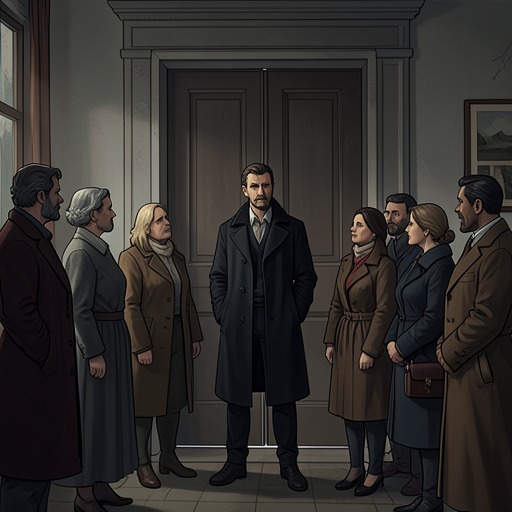
Lynching of Michael Donald
Just MercyThe Lynching of Michael Donald was a racist murder in Mobile that exposed how racial violence could be obscured by local law enforcement and challenged only after sustained pressure from the Black community and civil rights activists. It later stood as a vivid example of the racial terror that shaped the South after Reconstruction and of the history through which the modern death penalty developed.
The killing and its immediate context
The attack followed a mistrial in the prosecution of a Black man accused of shooting a white police officer. Many white people were shocked by the verdict and blamed the mistrial on the Black people who had been allowed to serve on the jury. After a cross was burned on the courthouse lawn, Ku Klux Klan members went looking for someone to victimize. They found Michael Donald, a young African American man walking home from a store in Mobile, about sixty miles south. The group severely beat him and hanged him from a nearby tree; his lifeless body was discovered several hours later.
Official Neglect and Public Pressure
Local police disregarded the apparent evidence that Michael Donald had been killed in a hate crime. Instead, they suggested that he might have been involved in drug dealing, a theory his mother adamantly rejected. The contrast between the attackers’ racial motive and the authorities’ speculation redirected attention from the violence itself and left the case without meaningful local investigation.
The failure to pursue the killing prompted the Black community and civil rights activists to press the United States Department of Justice to intervene. Two years later, three white men were arrested, and details of the lynching finally became public. The account thus turns on a reversal: a murder that local authorities had treated as something other than racial terror became legible through pressure from people the local response had failed to protect.
The Lynching’s Continuing Force
The killing did not remain confined to the night Michael Donald was attacked. Sheriff Tom Tate later invoked the lynching to threaten Walter McMillian, warning him that he could be hanged as Donald had been. The threat drew its force from a known act of racial terror: Donald’s murder had become a way to make the danger to Black men unmistakable, particularly when they were suspected of relationships with white women.
That association belonged to a longer history in which racial hierarchy was enforced through both law and violence. After Reconstruction, anti-miscegenation statutes prohibited interracial intimacy, while Southern law-enforcement officials treated punishing Black men who had been intimate with white women as part of their duty. Tate’s reference to Donald made the lynching an instrument of that enforcement, carrying its terror into the policing of McMillian as well as into the earlier attack.
The book places such violence within a history that extends beyond individual perpetrators. It describes racial terror after Reconstruction as a formative institution in American life and argues that lynching helped create the modern death penalty: speedy executions redirected some of lynching’s violent force while assuring white Southerners that Black men would still face the ultimate punishment. Donald’s murder thus appears not as an isolated horror but as part of a continuum in which racial violence could be carried out by a mob, minimized by local authorities, and echoed by the threat of state-sanctioned punishment.
Racial Power in the Courtroom
The book places the lynching’s continuing threat beside the racial arrangements of the criminal courts in which Walter McMillian was prosecuted. In 1987, all forty of Alabama’s elected district attorneys were white, including in a state with sixteen majority-Black counties. In jury selection, discretionary peremptory strikes remained a means of excluding Black prospective jurors: although the Supreme Court had ruled against racially discriminatory strikes, its original standard had proved so difficult to meet that the practice persisted. The 1986 decision in Batson v. Kentucky offered defendants a more direct way to challenge such strikes, but also prompted prosecutors to find more creative ways to exclude Black jurors.
The courtroom itself could make that unequal power visible. During McMillian’s trial, a metal detector and a police-held German shepherd stood inside the entrance, while benches occupied the previous day by his supporters were mostly filled with older white people supporting the Morrisons and the prosecution. These details do not make the courtroom another lynching; they show the different forms through which racial power operated around the case. The book’s account of Michael Donald’s murder therefore resonates beyond the mob attack: it belongs to a history in which racial terror and unequal legal institutions could reinforce the vulnerability of Black defendants.